

Table of Contents
- The Designer Furniture Value Proposition
- Craftsmanship and Manufacturing Standards That Justify the Cost
- How to Spot Quality Furniture: Beyond the Price Tag
- Resale Value of Designer Furniture: A Real Investment
- Fast Furniture vs. Heirloom Quality: The True Cost of Ownership
- When Designer Furniture Makes Sense (and When It Doesn't)
- The Middle Ground: Accessible Designer Aesthetics
- Conclusion
Last Updated: August 7, 2026
The Designer Furniture Value Proposition
Is designer furniture worth the price? The answer depends on what you value and how you define "worth." Designer furniture commands a premium, but premium doesn't automatically mean overpriced. The gap between mass-produced and designer pieces is structural, material-based, and measurable in years of ownership. When you buy designer furniture, you're purchasing a product engineered to last decades rather than seasons.
The real question isn't whether designer pieces cost more, they do. It's whether the additional investment returns value through durability, resale potential, and the satisfaction of owning something built with intention. This guide breaks down what makes these pieces different, how to spot quality you're actually paying for, and when the investment genuinely makes sense. We'll also explore when a designer aesthetic at an accessible price point, like what Unapologetic Luxury Designs offers, might be the smarter move for your situation.
Craftsmanship and Manufacturing Standards That Justify the Cost
True designer furniture is built fundamentally differently. Mass-produced furniture prioritizes speed and cost reduction through simplified joinery, affordable materials, and automated assembly. The result is functional but temporary, designed to perform adequately for 3-5 years.
Designer furniture inverts this equation. Craftsmanship becomes the cost driver. Hand-selected materials, precision joinery, and rigorous quality control add expense at every stage. A designer sofa frame uses kiln-dried hardwood with mortise-and-tenon joints; a mass-produced frame uses stapled plywood. Both hold a cushion, but only one remains structurally sound in 15 years.
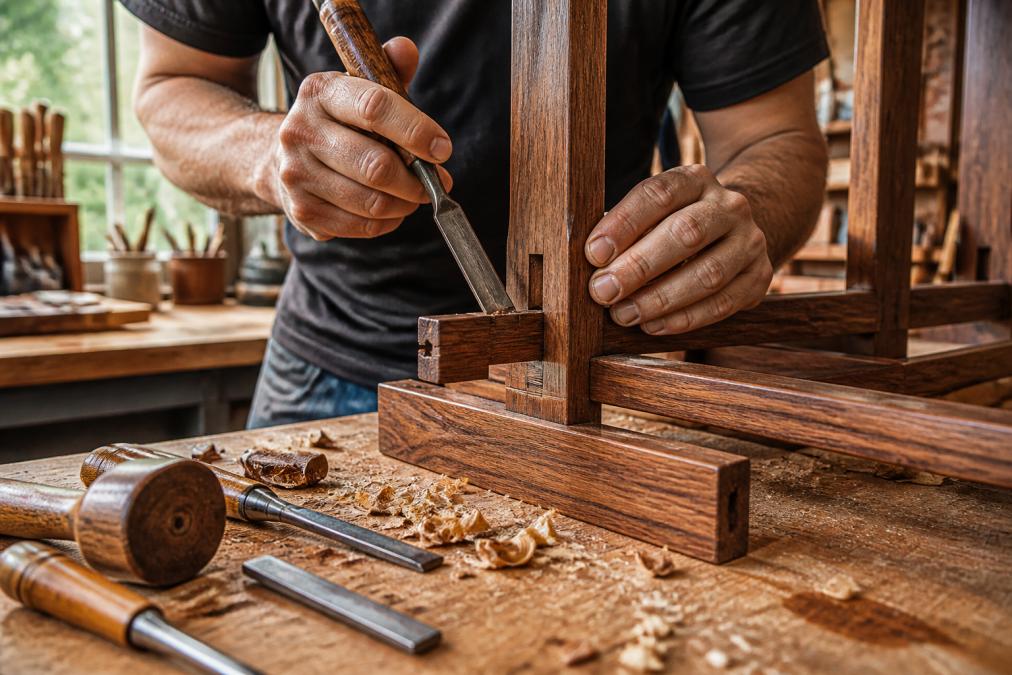
Consider upholstery: designer pieces often use eight-way hand-tied springs, where each spring is individually knotted to its neighbors, creating a responsive, long-lasting foundation. Budget furniture uses sinuous springs or foam-only construction, prone to sagging within 5-7 years. Wood selection matters too, designer makers source hardwoods like oak, walnut, and maple for grain stability and longevity. Budget furniture uses soft woods or veneers over particleboard, which peel and swell when wet.
Finishing processes also separate categories. A designer table might receive 12 coats of finish, sanded between layers, creating depth and protection. Mass-produced tables get two or three sprayed coats. One resists water rings; the other shows every spill.
How to Spot Quality Furniture: Beyond the Price Tag
Price alone tells you nothing. A $3,000 sofa can be poorly made; a $1,200 piece from the right maker can outperform it by years. Learning to spot actual quality saves money and prevents expensive mistakes.
Start with the frame. Flip a chair or sofa and examine the underside. Quality indicators include visible wood joinery (mortise-and-tenon joints, dovetails), hardwood frames (which sound solid when knocked), proper bracing (diagonal corner braces and center supports), and consistent construction with tight, uniform joints.
Examine upholstery attachment. On quality pieces, fabric is stapled or tacked with small, evenly-spaced fasteners. Pull gently on seams and edges, they should feel secure. Feel the cushions: press down and release. Quality cushions rebound quickly and completely. Check for zippers on covers, indicating the maker expects the piece to be maintained, not replaced.
Check drawers and moving parts by opening and closing them several times. Smooth, consistent action suggests quality hardware. Look at the finish by running your hand across surfaces, quality finishes feel smooth and even. Rough spots, drips, or visible brush marks suggest poor finishing.
Resale Value of Designer Furniture: A Real Investment
This is where designer furniture's value proposition becomes concrete. A well-chosen piece doesn't just last longer, it retains monetary value.
Mass-produced furniture depreciates immediately and steeply. A $2,000 sofa from a big-box retailer is worth $300-500 used within three years, a 75-85% loss. Designer pieces follow a different curve. A $4,000 designer sofa might sell for $2,200-2,800 used, a 30-40% loss. You've retained far better percentage value.
The resale market for designer furniture is strong and active. Platforms like 1stDibs, the online marketplace for designer and luxury furniture, Chairish, a curated marketplace for vintage and designer pieces, and Kaiyo, specializing in pre-owned designer furniture prove that demand exists. These are active markets where quality pieces sell quickly because buyers recognize the value proposition.
This resale potential changes the math of ownership. If you buy a $4,000 designer sofa, use it for eight years, and sell it for $1,500, your true cost is $2,500 over eight years, about $312 per year. A $2,000 mass-produced sofa needing replacement after five years costs $400 per year. The designer piece wins on cost-per-use.
Fast Furniture vs. Heirloom Quality: The True Cost of Ownership
The comparison between fast furniture and designer pieces reveals that the lowest price at purchase rarely means the lowest total cost of ownership.
Fast furniture is engineered for obsolescence. Materials are chosen for cost, not longevity. Assembly is simplified. The result is a product with a predictable lifespan: 3-5 years before structural failure, sagging, or damage makes replacement necessary.
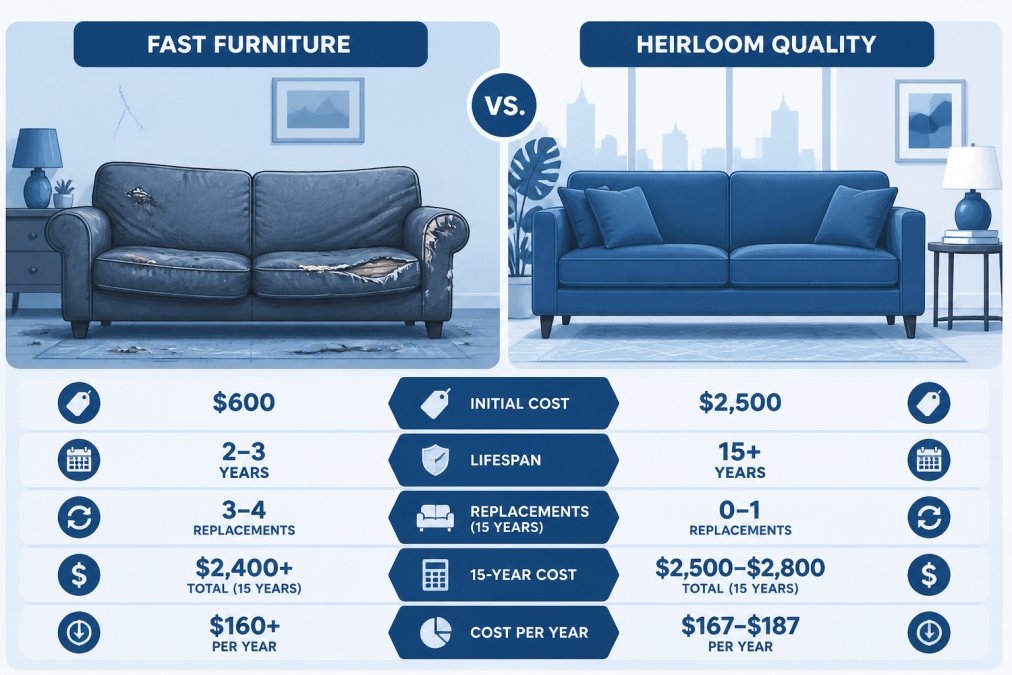
Heirloom-quality furniture is built to last generations. Solid wood frames don't weaken. Hand-tied springs don't lose tension. Quality upholstery can be replaced when worn, but the underlying structure remains sound.
Over 20 years, you might buy four fast furniture sofas ($2,000 each = $8,000 total) or one designer sofa ($4,000) that you sell for $1,500 after 15 years of use ($2,500 net cost). The designer piece wins on both total cost and environmental impact. There's also the intangible factor: living with a piece you know will last creates confidence that you've made a sound investment.
When Designer Furniture Makes Sense (and When It Doesn't)
Designer furniture isn't universally the right answer. Context matters.
Designer furniture makes sense when:
You plan to keep pieces long-term (10+ years), use furniture heavily (sofas, dining tables, everyday chairs), value design consistency, and can afford the upfront cost without financial strain.
Designer furniture doesn't make sense when:
You're furnishing on a tight budget, your tastes change frequently, you're still figuring out your style, or you need flexibility due to rental situations or uncertain futures.
The Middle Ground: Accessible Designer Aesthetics
There's a category between mass-produced fast furniture and high-end designer pieces: accessible designer-quality furniture. Brands like Unapologetic Luxury Designs operate here, offering designer-caliber aesthetics and solid construction at prices between fast furniture and luxury boutiques.
These makers achieve this through smart choices: curating bold, timeless designs; using quality materials without unnecessary luxury finishes; manufacturing at scale; and selling direct-to-consumer to eliminate retail markups. The result is furniture with real craftsmanship, thoughtful design, and durability far exceeding fast furniture, at accessible prices.
Unapologetic Luxury Designs curates bold, modern pieces that blend sculptural beauty with everyday functionality. Their collections are designed to be statement pieces that elevate a space through distinctive aesthetics and solid construction. They deliver high-end, designer-quality aesthetics at an accessible price point. The trade-off is clear: you're not buying from a heritage luxury brand. You're buying contemporary design and quality construction.
Conclusion
Is designer furniture worth the price? Sometimes, and it depends on your situation.
Designer furniture delivers real value through superior craftsmanship, durability, and resale potential. If you plan to keep pieces long-term, use them heavily, and can afford the upfront investment, designer-quality furniture pays dividends.
But designer furniture isn't the only path to quality. Accessible designer-quality brands offer a middle ground: thoughtful aesthetics, solid construction, and real durability at accessible prices. Unapologetic Luxury Designs exemplifies this approach, delivering bold, modern pieces with enduring craftsmanship at accessible prices, transforming living spaces into sophisticated sanctuaries without the boutique price tag.
The real decision isn't designer versus budget. It's durable versus disposable, intentional versus convenient. Once you frame it that way, the value becomes clear. Shop All and discover how quality design at an accessible price point can elevate every corner of your home.
Frequently Asked Questions
What makes designer furniture worth the price compared to mass-produced alternatives?
Designer furniture justifies its cost through superior craftsmanship, material integrity, and longevity. High-end pieces use solid wood construction, quality upholstery, and precision joinery that withstand decades of use. Mass-produced furniture relies on particle board, synthetic materials, and assembly-line manufacturing that deteriorate within 3-5 years. When calculated as cost-per-use over 15-20 years, designer furniture often costs less annually than replacing budget pieces multiple times.
Does designer furniture hold its resale value?
Authentic designer furniture from established makers typically retains 40-60% of its original value, especially pieces with strong design heritage and timeless aesthetics. Brands known for quality construction and iconic designs appreciate or maintain value on secondary markets like 1stDibs, Chairish, and Kaiyo. Fast furniture depreciates to near-zero value. Investment-grade pieces from renowned designers can even appreciate if they become scarce or culturally significant.
How can I tell if furniture is genuinely high-quality or just expensive?
Examine the frame construction (solid wood vs. particle board), joinery methods (mortise-and-tenon vs. staples), upholstery materials (natural fabrics vs. polyester), and hardware quality. Check for hand-finishing, attention to detail, and manufacturing provenance. Designer brands publish construction specifications; mass-market retailers avoid detail. Request product documentation, inspect seams and joints in person if possible, and verify the maker's reputation through design publications and professional reviews.
Is there a way to get designer aesthetics without paying full designer prices?
Yes. Curated retailers blend design-forward aesthetics with accessible pricing by selecting statement pieces from emerging designers and smaller manufacturers who prioritize craftsmanship over brand markup. Pre-owned designer furniture through resale platforms offers 30-50% discounts on authenticated pieces. You can also invest selectively in one or two iconic statement pieces and balance them with quality mid-range furniture. Many design-conscious brands now deliver sophisticated, sculptural pieces at fraction-of-luxury pricing without sacrificing durability or aesthetic integrity.
This article was written using GrandRanker